

Apr 15, 2010

Apr 10, 2010

Apr 1, 2010
Free Softwares
You say u search a way to make your own music but you dont have a $ in your pocket?
Now, no excuses!
Feb 23, 2010


Feb 16, 2010
Beat Boxer
Mr Mike Glozier Play Mr GEntleman Aaron Funk Aka Venetian Snares
The drummers become, in parallel to digital technology, better and better and millimetre-length addicts.
Jan 29, 2010
Dance? Sound Design? Visuals? Noise? Hiroaki Umeda!

I saw Hiroaki Umeda yesterday at CTM transmediale Festival in Berlin.
Except a little baby in the audience who did not appreciated the super high frequencies part, it was so fresh and amazing that I've decided to post something about it, and will probably included some sound parts I've recorded (stoled) with my little and so handy shave unit Q3.
In few lines, Hiroaki Umeda has earned a reputation as one of Japan’s most exciting dance artists, using lighting, projections, self-created music and a powerful dance technique to create striking solo dance pieces.
Except a little baby in the audience who did not appreciated the super high frequencies part, it was so fresh and amazing that I've decided to post something about it, and will probably included some sound parts I've recorded (stoled) with my little and so handy shave unit Q3.
In few lines, Hiroaki Umeda has earned a reputation as one of Japan’s most exciting dance artists, using lighting, projections, self-created music and a powerful dance technique to create striking solo dance pieces.
Born in 1977, he studied photography at Nihon University and began dancing at the age of 20, having trained in classical ballet and hip-hop. In 2000 Umeda founded his own company, S20, and has showcased his work at cutting-edge dance festivals in Korea, Japan), Italy, France and Canada. while going to a condition, which will be presented at the PuSh Festival along with Accumulated Layout January 22-24, has been described as “a visual and sensorial experience . . The discovery of a young artist, both original and promising.”
Hiroaki Umeda - Adapting for distortion
Bringing elements of hip hop, ballet and butoh, Umeda has said in interviews, “there are no conceptual themes in my shows, which I empty of everything that might constitute a meaning”. Alternating between stillness and frenzy against a background of projected images and a cacophony of sounds, Umeda constructs meaning out of chaos, disorientation and sensation.
Jan 20, 2010
The Loudness War Analyzed
Recorded music doesn’t sound as good as it used to. Recordings sound muddy, clipped and lack punch. This is due to the ‘loudness war’ that has been taking place in recording studios. To make a track stand out from the rest of the pack, recording engineers have been turning up the volume on recorded music. Louder tracks grab the listener’s attention, and in this crowded music market, attention is important. And thus the loudness war – engineers must turn up the volume on their tracks lest the track sound wimpy when compared to all of the other loud tracks. However, there’s a downside to all this volume. Our music is compressed. The louds are louds and the softs are loud, with little difference. The result is that our music seems strained, there is little emotional range, and listening to loud all the time becomes tedious and tiring.
Jan 15, 2010
All we have is Noise! Alvin Curran - Canti E Vedute Del Giardino Magnetico (1974)


ANANDA
ananda N. 1 Vinyl LP 1974
ananda N. 1 Vinyl LP 1974
Composer Alvin Curran (born December 13, 1938) is the co-founder, with Frederic Rzewski and Richard Teitelbaum, of Musica Elettronica Viva, and a former student of Elliot Carter. Curran's music often makes use of electronics and environmental found sounds. He was a professor of music at Mills College in California until 2006 and now teaches privately in Rome, Italy, and sporadically at various institutions. Since 1996, Curran has worked on a growing series of solo piano pieces entitled Inner Cities.
Rare original copy (and insanly expensive) of Canti E Vedute Del Giardino Magnetico (1974), that has to be considered the Alvin Curran's most lyrical collage, scored for for tape, voice, flugelhorn, synthesizer and tape of natural sounds (wind, high-tension wires, frogs, beach waves, etc). "Though I have been making music for some time, "Canti E Vedute Del Giardino Magnetico" is for me like a first piece. It marks a radical departure from the previous 7 years of experimental and collective music making with the group MEV and it signals my beginning in the strenuous role of a solo performer-composer.I recorded and engineered (often while playing) by myself, using Schoeps condenser mics, an AKG D 224 (flugelhorn) and an RCA 77 DX (voice) into a mixer by Livio Argentini and a Revox A 77. Instruments heard in order of appeareance are: Synthesizer (SYNTHI A), Amplified cymbal, my voice with glass chimes, flugelhorn with Harmonicas and jews harps and the voice of Margherita Benetti singing an Emillian folk song. On side 2: synthesizer with African thumb piano (Kalimba), metal chimes and corrugated plastic tubes" Alvin Curran.
"Though I have been making music for some time, CANTI E VEDUTE DEL GIARDINO MAGNETICO is for me like a first piece. It marks a radical departure from the previous 7 years of experimental and collective music making with the group MUSICA ELETTRONICA VIVA and it signals my beginning in the strenuous role of a solo performer-composer…" Alvin Curran
Website
Website
Jan 13, 2010
Philippe Sarde, Le Locataire Aka The Tenant (Polanski, 1976)


Key composer of the 70s and 80s French cinema, Philippe Sarde is a fantastic chameleon, entirely devoted to the film vision of a director. He has composed music of an astonishingly wide range and at an amazing rate. Some critics find his body of work devoid of an overall style or personal imprint, but that is Sarde's intent. For Sarde, the music evolves from the film, from the director's idea of the film and his directorial style. Consequently, his musical compositions are as diverse as the films he scores.
Read more about Philippe Sarde & his discography here/link in cover/
Jan 7, 2010
Time Lapse: Suite
3:06 a.m.Calma while searching for some pics for some new animations. Hands work / da key..
If u didnt check already my older post about Blu art, its time to do it here.

Andrea y Screw, Monterrey, Nuevo León, México
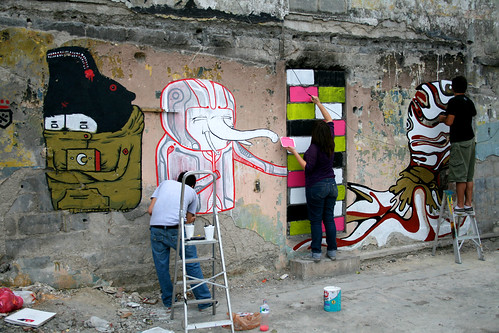
Augustine Kofie. another brain, & structures, for pleasure.

please visit his website to see for more material and nice music.
Collected works of Augustine Kofie
Nov 12, 2009
Sound Structure/Sculpture: Felix's Machine


Felix’s Machines are music making sculptures. They were constructed in his bedroom and exist to facilitate music by translating rhythmic audio structures into a three-dimensional visual show.
They function as musical instruments as well as kinetic sculptures. The Machines are a performance device, but can be well suited to act as an art installation, theatre accompaniment, or standalone sculpture.
The Machines invite an audience to share the experience of their creator. He aims to exploit the complexity found behind the workings of most digital music and present it as a more accessible equivalent. These Machines do not intend to match human potential. Instead they exist to test the advantages of mechanical instruments alone.
Winter 2007: early stage of development
Winter 2008: Extract from composition: 'Glide' recorded and filmed at Gasworks
Machines: Felix Thorn
DOP: Tom Swindell
Editor: Chris Barnet
Director: Tom Mansfield
DOP: Tom Swindell
Editor: Chris Barnet
Director: Tom Mansfield
Nov 6, 2009
Emergency Broadcast Network: EBN VHS copies is back!

Emergency Broadcast Network is the name of a multimedia performance group formed in 1991 that took its name from the Emergency Broadcast System. The founders were Rhode island school of Design graduates Joshua Pearson, Gardner Post and Brian Kane (author of the Vujak VJ software).
Kane left EBN in 1992. The EBN Live Team included DJ Ron O'Donnell, video artist/technologist Greg Deocampo (founder of Company of Science and Art (Cosa)), artist/designer Tracy Brown and technologist Mark Marinello.

Josh Pearson, EBN's charismatic front man and principal performance artist, was also EBN's music composer and main video editor. The music and video editing techniques he personally developed and refined have been hugely influential on a generation of advertising and music video editors.
The first EBN video project was a musical remix of the Gulf War, created in 1991 as the war was still ongoing. The VHS tape of the remix project, which contained the George H.W. Bush "We Will Rock You" cover, became a viral underground hit, and was distributed widely by fans as bootleg copies. In the summer of 1991, EBN traveled with the first Lollapalooza tour, distributing tapes and showing their videos on a modified station wagon with TVs on the roof. The group also became well known for their media sculptures and stage props which were created by Gardner Post.
The EBN modus operandi was to take cable television broadcasts and remix them with a funky beat, often having the lyrics "sung" not by a singer but by half-second sound clips from TV, spliced together. For example, the lyric "electronic behavior control system" would be created with a clip of Ross Perot saying "electronic", followed by a clip of Georges H. W. Bush saying "behavior", then Ted Koppel saying "control", and finally a clip of Bill Clinton saying "system". This technique has been named Video scratching (Not to be confused with the British video art movement).
Among their videos are "Get Down" and "Electronic Behavior Control System" from their 1995 album Telecommunication Breakdown, which mocks the way television controls our lives. Another was a cover of "We Will Rock You " by Queen, with a vocal track made up of remixed clips of Georges W. Bush making announcements about the Gulf War. Bono of U2 took notice of their work and hired them to provide visuals for their Zoo Tv Tour. EBN's video work featured prominently into the show, and their "We Will Rock You" cover was played at the beginning of each show. EBN also produced visuals for The Edge's performance of "Numb" on the 1993 MTV Video Music Awards. In addition to the visuals, audio from those clips were featured in the live performance to create rhythmic effects.
Here is one of the clearest versions I have ever found. I have seen an original VHS tape in the early 90s, and to my memory this seems like it, however short it was. Is also very hard to find any EBN video material since most of it was contained on VHS and those tapes never last after many years of use. So if you own an original VHS of Any EBN work, please rip it and upload for the community, thanks a lot!
Take it here, here and here
Take it here, here and here
more @ www.joshualpearson.com
Nov 5, 2009
Bästard - radiant, discharged, crossed off

Following in the hyper-underground-shamefully-too-unknown-noise-bands-from-the-last-decade, Born from the ashes of Lyon's hardcore band Deity Guns, Bästard is now considered as a very important band in the nowadays music's landscape. During the early 90's, those pioneers have reached to an uncommon sound inspired by Sonic Youth and others Einsturzende Neubauten. From their beginning, they kept in their music that kind of fury, but used it 'til the end masterfully and always with some more inventiveness. Once became Bästard, they progressively abandon their noisy way of playing, to better include new sounds : samples and violin appear on the eponym album "Bästard" and this was only a beginning. Always looking after exciting sounds, they came to collaborate with jazz-clarinettist Denis Colin or experimental musician Erik Minkinnen (also famous for his Sister Iodine project). Many songs will be released on Ep's and all those will be compiled on "Side Stuff" Lp. It's in 1996 that the band peaked. "Radiant, Discharged, crossed off…" is still saluted by the whole press critics, as an essential post-rock work. Recorded by Andy Briant (member of Tortoise), this LP remains a classical advanced on his time, that pushed back the frontiers of music. Including the open minded attitude of jazz and industrial soundscapes, the result is still astounding.
I listen to this album again and again and again..
/link in cover/
I listen to this album again and again and again..
/link in cover/
Nov 4, 2009
Sound Design: Berna

Between the 1950s and the mid 1960s, long before Robert Moog and Wendy Carlos injected electronics into pop-music (with a few exceptions like the Barrons and Raymond Scott), electroacoustic music was pioneered by european radio laboratories and US universities. Composing with tapes and electronics was a serious painstaking and expensive affair, prerogative of a restricted elite of contemporary music composers and adventurous sound engineers. At that time there wasn’t any electronic musical instruments market, as a matter of fact, most of the equipment was adapted from scientific tools belonging to radio engineering departments. Sometimes the equipment was built from scratch cannibalizing anything that had wires, tubes and pots, more rarely, the studios used the few commercial instruments available in those days, such as the Melchord, the Trautonium and the Theremin. Contrarily to what happens today, electronic music then was everything but fast and easy to create. A few minutes of electronic composition could take more than one year of work. Everything was handmade, from complex timbres with multiple sine oscillators bounces to tape editing with scissors and scotch-tape. Even sound envelopes were manually built by cutting tapes’ edgdes at different degrees of inclination. Ussachevsky’s ADSR was yet to be invented!
Berna is a software simulation of a late 1950s electroacoustic music studio. Oscillators, filters, modulators, tape recorders, mixers, are all packed in a easy-to-use interface with historical accuracy.
Explore serial, concrete and tape music or create strange new sonic worlds with instruments inspired by the greatest studios of the early days of electronic music. Are you ready to meet the grandfather of the synthesizer?
from Tobor Experiment
Berna is a software simulation of a late 1950s electroacoustic music studio. Oscillators, filters, modulators, tape recorders, mixers, are all packed in a easy-to-use interface with historical accuracy.
Explore serial, concrete and tape music or create strange new sonic worlds with instruments inspired by the greatest studios of the early days of electronic music. Are you ready to meet the grandfather of the synthesizer?
Subscribe to:
Posts (Atom)

 Posts
Posts


